Why Kubernetes is called K8s, and what the Greek means
K8s is a numeronym — K, eight letters, s. Kubernetes itself is the ancient Greek κυβερνήτης, the helmsman of a ship. The seven-spoked logo is a Star Trek easter egg. The thing it names is the third generation of Google's internal scheduler.
AI-assisted postDrafted with help from Claude, edited and fact-checked by Mart. See transparency policy →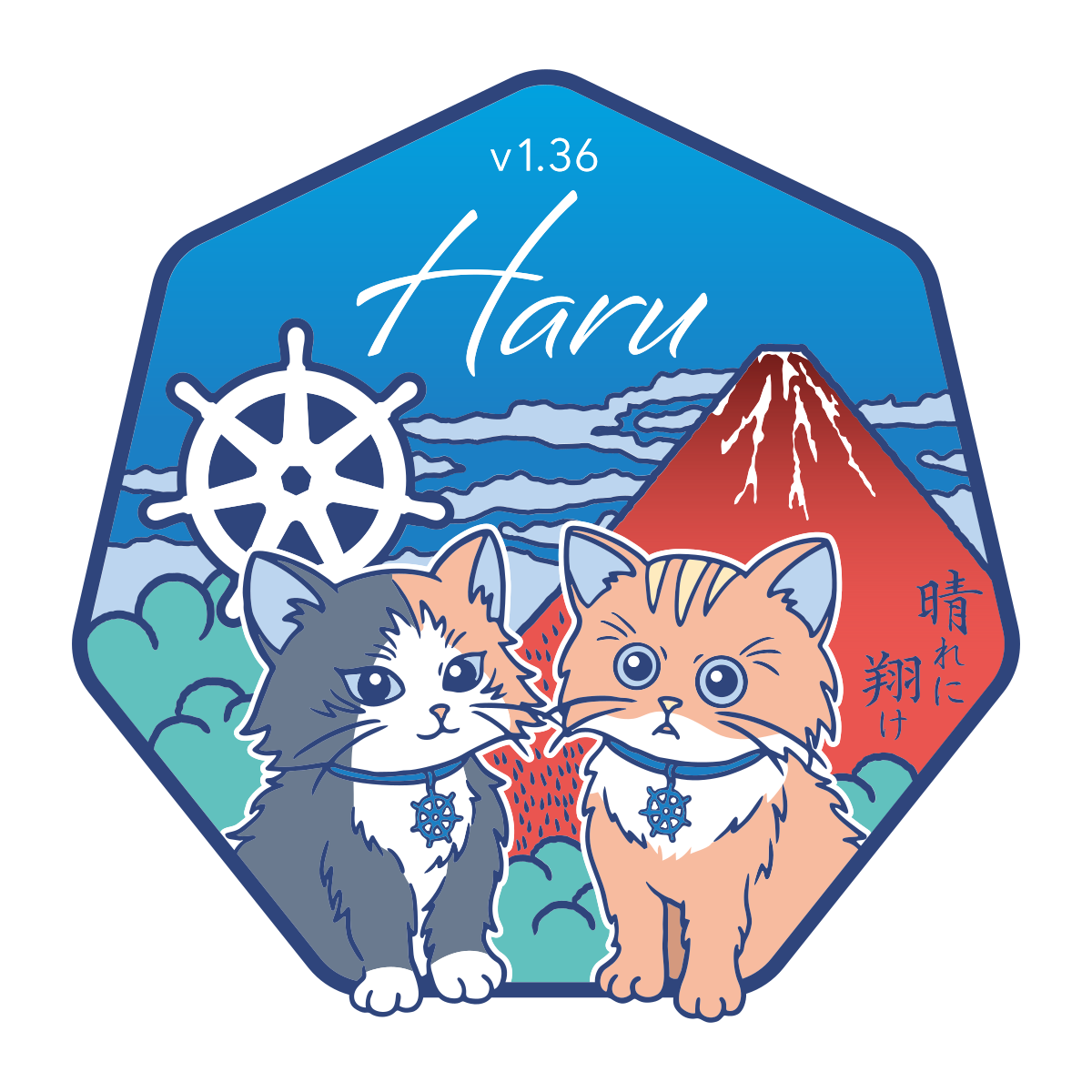
The Kubernetes v1.36 "Haru" release logo (CNCF), April 2026. The ship's wheel is no accident — the name means "helmsman" in Greek.
The name Kubernetes is the ancient Greek word κυβερνήτης (kubernḗtēs), meaning helmsman or pilot of a ship. The same root produced cybernetics in English through Norbert Wiener's 1948 book, and governor through the Latin borrowing gubernator. The metaphor is older than computing by two and a half thousand years and is doing exactly the work it was always doing: naming the person who steers something complex through conditions that change faster than a single course-correction can absorb. That the thing it now names is a container scheduler descended from Google's internal infrastructure is the more recent half of the story.
The numeronym
K8s is not an acronym. It is a numeronym — a contraction in which a number stands for the count of letters between the first and last character of a word. K, then eight letters (ubernete), then s. The convention shows up everywhere in computing once you look for it: i18n (internationalization, eighteen letters between the first i and the last n), l10n (localization), a11y (accessibility), l11n (legalization, rare), w3c in the same family. The pattern dates to digital equipment manuals from the 1980s, where engineers needed to type long words like internationalization repeatedly and noticed the dollar saving from typing four characters instead of twenty.
The numeronym tends to survive in writing — chat, code comments, slide decks — while the spoken form stays full or shortened differently. People say Kubernetes and Kube out loud; they write K8s. The same split happens with i18n — spoken as eye-eighteen-en by people who actually use the word, but mostly written.
The Greek
The original Greek κυβερνήτης appears in Homer, Plato, and the Septuagint, used both literally (the person physically steering a ship) and metaphorically (the person guiding a city, an enterprise, or a soul). Plato's Republic uses it to argue that a state ought to be steered by those who know how to steer, an argument that governor later inherited through Latin.
Norbert Wiener picked the same Greek root in 1948 for Cybernetics: Or Control and Communication in the Animal and the Machine, the founding text of the field. Wiener was looking for a word that captured control through feedback without committing to a particular substrate (mechanical, biological, electronic). The Greek captured it because that is what a helmsman does: continuously read the conditions and adjust the course. The Latin descendant governor is, mechanically, exactly the same thing: the Watt steam governor of 1788 used flyweights to throttle a steam valve in response to engine speed. Same word, same metaphor, applied to a different machine.
The logo
The Kubernetes logo is a seven-spoked ship's wheel. The wheel is the obvious helmsman reference, but the seven spokes are not arbitrary — and not nautically accurate either. A real ship's wheel almost always has an even number of spokes, usually eight, sometimes six, ten, or twelve, because the spokes double as handles spaced evenly around the hub. Seven is the tell that this wheel is carrying a second meaning. Kubernetes was internal at Google under the codename Project Seven of Nine — a reference to the Star Trek: Voyager character Seven of Nine, a former Borg drone. The Borg connection is the pun: Kubernetes is the third-generation descendant of Google's internal Borg scheduler, and Seven of Nine is a Borg character who became more humanised over the series. The seven spokes preserve the codename in the logo of the open-source project. Google designer Tim Hockin has confirmed this publicly.
The Helm logo (a ship's wheel from a different angle, with the package-manager wordmark) and the Helmsman icon on the Kubernetes documentation are the other half of the visual identity. Everything maritime.
Borg, Omega, Kubernetes
Inside Google, container orchestration ran on a system called Borg, the existence of which was described in a 2015 paper but which had been in production since roughly 2003. Borg scheduled containers across Google's data centre fleet — long before container meant Docker — and the lessons learned from running it at Google scale informed everything that came after.
A second-generation effort, Omega, began around 2013. Omega was a rewrite that tried to fix Borg's centralised scheduler by using optimistic concurrency over a shared state store. Omega never replaced Borg; it ran alongside as an experimental platform.
Kubernetes was the third generation, started in 2014 by Joe Beda, Brendan Burns, and Craig McLuckie, with later contributions from Tim Hockin, Brian Grant, and Dawn Chen. The deliberate decision was to build it externally, in the open, with an API surface that took Borg's hard-won lessons but did not carry Borg's internal Google-isms. The first commit landed on 2014-06-07. The public announcement was at DockerCon on 2014-06-10. Version 1.0 shipped on 2015-07-21, at which point Google donated the project to the Cloud Native Computing Foundation — the Linux Foundation sub-organisation that has held it since.
The lineage is sometimes summarised as Borg → Omega → Kubernetes, which is roughly right with one caveat: Omega was not a strict ancestor. The architectural ideas that came out of Omega informed Kubernetes' design, but Kubernetes is not a direct evolution of Omega's code or scheduler.
The maritime naming family
The container ecosystem leans hard on shipping metaphors. The list is not short:
- Docker — a longshoreman, the worker at a port who loads and unloads containers. See the Docker post.
- Kubernetes — the helmsman.
- Helm — the chart-based package manager. Same nautical root.
- Harbor — the container registry. Where the ships dock.
- Portainer — the web UI. Port + container, also a real word (a smaller container shipped in a larger one).
- Captain — Rancher's CLI, several other projects.
- Skipper — a load balancer from Zalando.
- Tiller (deprecated) — the early Helm server-side component, named after the steering lever on a small boat.
- Argo — the workflow engine, named after Jason's ship.
- Flotilla, Fleet — earlier Kubernetes-adjacent tools, both nautical.
The metaphor stack is so consistent that any new container-ecosystem product with a maritime name is broadly intelligible without further explanation. The reverse is also true: a project that breaks the metaphor (Knative, Istio, Crossplane) usually has a different origin story.
Why "K8s" survived
The full name is four syllables and ten letters, which is too many for chat and code comments. The shortened spoken form Kube is one syllable and four letters, which is fine for conversation but ambiguous in writing (does kube mean the project, the binary kubectl, the API, a single resource?). The numeronym K8s sits in between: short, unambiguous, easy to type, easy to grep for in a log file. It is the form that survived in writing because it solves the writing-specific problems.
The naming is consistent with the broader Greek-and-machinery pattern: the original word is dignified and meaningful and slightly out of date, the spoken contraction is informal and useful, and the written contraction is the canonical reference everyone agrees on. Same shape as Internationalization / i18n, Accessibility / a11y, and a hundred other long technical terms whose written form has migrated to a digit-based shorthand over the last twenty years.
A short close
The name is older than every other piece of technology in the modern data centre. The thing it names is the third in a line of schedulers that ran Google's infrastructure before Google could name them publicly. The logo encodes a Star Trek joke that was a working title. K8s is the short form that solves a writing problem, not an acronym for any phrase. Most engineers using Kubernetes daily do not know any of this. Most engineers do not need to. But the consistency of the naming — Greek root, maritime metaphor, numeronym convention, Borg lineage — is rare enough in computing infrastructure that the etymology is worth keeping straight.
Read next