Where the name Docker comes from
A docker is a longshoreman — the worker at a port who loads and unloads shipping containers. The software took its name from the work; the work took its metaphor from the 1956 standardisation of physical shipping containers. The container ecosystem inherited the maritime vocabulary.
AI-assisted postDrafted with help from Claude, edited and fact-checked by Mart. See transparency policy →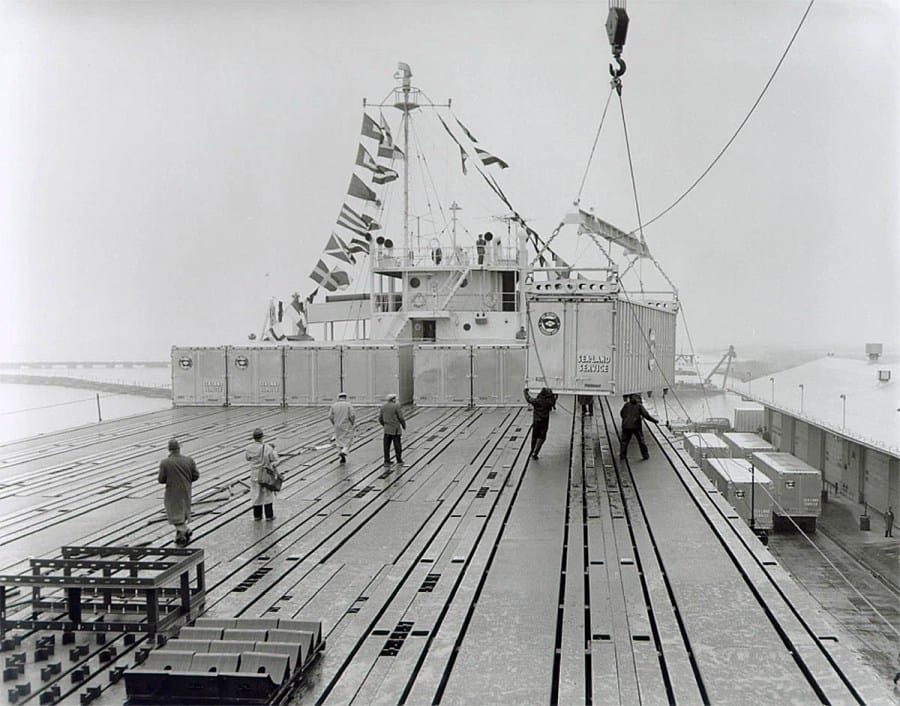
Containers being loaded onto the SS Ideal-X, 1956 — the first containership voyage, the moment the docker's job changed forever. Image: Maersk/SeaLand.
A docker, in the original sense of the English word, is a longshoreman: the worker at a port who loads and unloads cargo from ships. The job exists because ports are the hinge between two transport systems — ship and shore — and somebody has to move the cargo between them. Once shipping containers were standardised in the 1950s, the docker's job standardised with them: each container was a sealed, rectangular box that the docker did not need to open, did not need to inventory, and could move with the same crane and the same hooks regardless of what was inside. The software named Docker, launched at PyCon US in March 2013, took the same trick and ran it for software packages instead of physical goods. The name is straightforward; the metaphor is the load-bearing part.
The 1956 breakthrough
The shipping container as a standard unit of cargo is sometimes attributed to Malcolm McLean, an American trucking-company owner who in 1956 fitted a tanker ship — the Ideal-X — with a deck rack capable of holding 58 stackable steel boxes. The first voyage left Newark, New Jersey on 26 April 1956 carrying those 58 containers to Houston. McLean's insight was that the dockside time was where most of the cost of moving cargo lived: a ship in port loaded one item at a time was burning capital in the form of crew wages, fuel idle, and quay fees. Standardising the container collapsed the loading time from days to hours. The downstream effects — port automation, the death of the traditional longshoreman, the rise of intermodal freight, the globalisation of manufacturing — are usually attributed to the same standard.
ISO formalised the dimensions over 1968–1970 as ISO 668. A standard twenty-foot container (TEU) became the unit of measurement for global shipping capacity. By the early 1970s, the cost of moving a ton of cargo across the Atlantic had fallen by roughly an order of magnitude relative to the breakbulk era. The container, as an abstraction, did for cargo what shrink-wrap later did for retail: it separated the what from the how.
This is the metaphor the Docker software was reaching for. A piece of software has dependencies — libraries, runtimes, environment variables, file-system layout, network configuration — and shipping that software between machines used to mean reconstructing the dependency graph at the destination. The packaging cost was the docker's loading time. The Docker container collapsed that cost the same way McLean's container had: by enforcing a sealed, standard unit and pushing the differences out of the loading interface.
dotCloud and the pivot
The company that became Docker, Inc. was originally dotCloud, a Platform-as-a-Service startup founded in Paris in 2010 by Solomon Hykes and Sebastien Pahl. dotCloud's product was a managed deployment platform that ran customer code in Linux containers (LXC) on shared hosts. The internal tool that became Docker started life as the part of the dotCloud platform responsible for packaging applications into container images and shipping them between hosts.
By 2012 the dotCloud team had realised the internal tool was more valuable than the platform it lived inside. Hykes gave a five-minute lightning talk at PyCon US on 13 March 2013 titled "The future of Linux Containers", demonstrated the tool, and open-sourced it the same day under the Apache 2.0 licence. The talk did the rest. Within months the project had thousands of GitHub stars, hundreds of contributors, and the kind of mindshare that dotCloud-the-platform never reached.
In October 2013 the company renamed itself from dotCloud to Docker, Inc., and over the following two years the original PaaS business was sold off (to cloudControl) so the company could focus entirely on the container engine. The renaming was the public acknowledgement that the side project had eaten the main product.
What a docker actually does
The English word docker has been in use since at least the early 19th century, derived from dock (a basin where ships are loaded) plus the agent suffix -er. Synonyms across English-speaking countries: longshoreman (American), stevedore (broadly maritime), wharfie (Australian), dock worker (generic). The job is the same: physically move goods between ship and shore, increasingly with cranes and forklifts since the 1960s, but historically by hand, by gang, with hooks.
The Docker logo — Moby Dock, a whale carrying shipping containers. Docker, Inc.
The Docker logo — the Moby Dock whale, a blue cetacean carrying shipping containers stacked on its back — is the same metaphor with a layer of cartoon abstraction. The whale is not part of the original etymology; it is a visual joke about a creature large enough to carry containers across the ocean. Moby Dock's name extends the Melville reference in a different direction: in 2017 Docker, Inc. open-sourced the upstream engine codebase as the Moby project, retaining the Docker name for the commercial product.
The technical heritage: LXC → libcontainer → runc → OCI
Docker's earliest releases — through about version 0.9 in March 2014 — used LXC as the underlying containerisation primitive. LXC was itself a higher-level wrapper around the Linux kernel features that made containers possible: namespaces (introduced through the 2.6 series, finalised around 2008), cgroups (Google, merged 2007–2008), and capabilities. In March 2014, Docker 0.9 replaced LXC with their own Go-language implementation, called libcontainer, removing the LXC userland dependency.
In June 2015, the Open Container Initiative (OCI) was founded under the Linux Foundation with Docker, CoreOS, Red Hat, Google, and others as founding members. Docker contributed libcontainer as the basis for runc, the reference implementation of the OCI runtime spec. The OCI Runtime Specification and Image Specification became the standards that every modern container tool — Docker, Podman, containerd, CRI-O, BuildKit, Buildah, Kaniko — implements. The standardisation was the moment Docker stopped being a single project and started being an ecosystem.
The maritime naming family
Docker named the work; almost every project that built around it named the metaphor. The container-tooling ecosystem in 2026 is a small thesaurus of maritime vocabulary:
- Docker — the longshoreman.
- Kubernetes — the helmsman (Greek κυβερνήτης).
- Helm — the steering apparatus; Kubernetes' chart-based package manager.
- Harbor — a container registry maintained by CNCF.
- Portainer — a container management UI. Port + container; also a real word.
- Tiller — the lever that turns the rudder; the original Helm server-side component (deprecated in Helm 3).
- Captain — Rancher's CLI; various other projects.
- Skipper — Zalando's HTTP load balancer.
- Argo — Jason's ship, from the Argonauts.
- Flotilla, Fleet — earlier Kubernetes-adjacent multi-cluster tools.
- Anchor — several smaller projects.
- Moby — Docker's own upstream open-source identity, from Melville.
The convention is strong enough that any new container-ecosystem project with a maritime name is broadly intelligible without further explanation. A project that does not use a maritime name — Istio, Knative, Crossplane, Linkerd — generally has a different origin story.
Why the metaphor stuck
The Docker metaphor stuck for the same reason McLean's original container stuck: it standardises the load-bearing interface and pushes all the variation inside. A Docker container is, from the outside, a sealed unit with a fixed contract — image format, runtime API, network and volume mounts — and the contents are an implementation detail of whoever built the image. A scheduler does not need to know what's inside; a registry does not need to know; a CDN does not need to know. The metaphor mirrors the engineering choice, and the engineering choice mirrors the metaphor, which is exactly the kind of reinforcement that makes a name travel.
A short close
The name is the work. A docker loads and unloads sealed containers. The software does the same for software packages. The metaphor is faithful enough that the rest of the ecosystem could borrow from the same dictionary — helmsman, helm, harbor, port — without breaking the mental model. The 1956 standardisation that made physical shipping a global system has, sixty-eight years later, given the software industry its dominant packaging vocabulary. The double pun is intentional: the longshoreman and the box he moves are doing the same conceptual job in both places.
Read next