Where the word port comes from (in networking)
A network port is a numbered endpoint that lets one host run many services at once. The word traces from the Latin for a gate or harbour, through the general computing sense of a connection point, into the TCP/IP port formalised by Jon Postel and Vint Cerf in the early ARPANET RFCs.
AI-assisted postDrafted with help from Claude, edited and fact-checked by Mart. See transparency policy →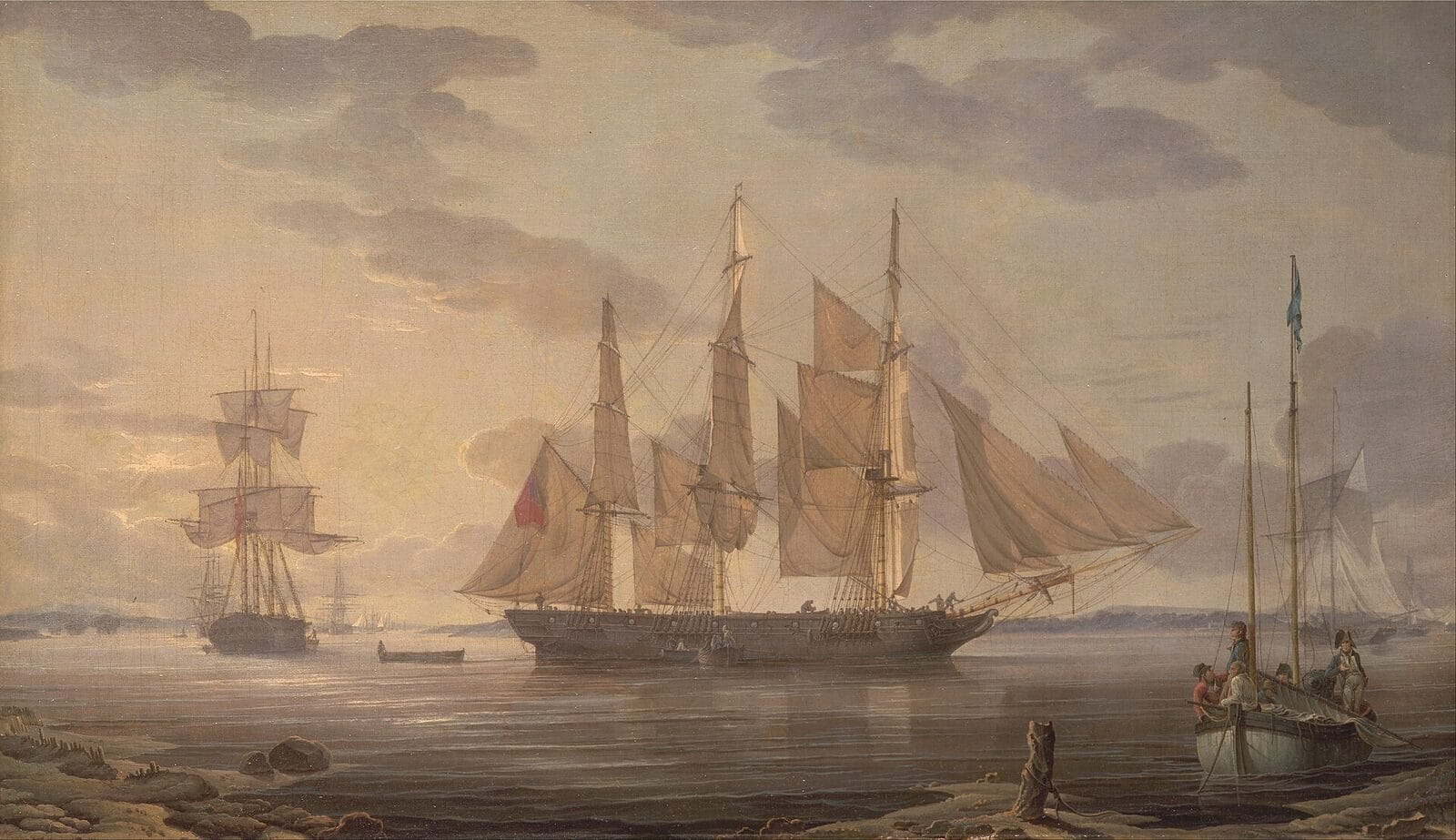
Robert Salmon, "Ships in Harbor" — a port: the controlled place where things dock, load, and leave. Public domain.
When you write :443 or :51820, you are using a word that arrived in networking by a long route — from harbours, through hardware, into the abstractions that let a single machine answer thousands of conversations at once. It is worth separating the networking sense from the unrelated "porting software to another platform," which comes from a different root entirely.
The old word: a gate, a harbour
The networking sense descends from the Latin porta (a gate or door) and portus (a harbour) — a place where things enter and leave in a controlled way. That harbour image is the useful one: a harbour has many numbered berths, and a ship docks at a specific berth to be loaded or unloaded. One harbour, many berths, each handling a different vessel. Hold onto that picture, because the network port is almost exactly it.
Computing first used "port" for the physical sense — a hardware port is a socket where you plug something in, a controlled point of connection. The networking port is the same idea made abstract: not a physical socket, but a numbered point where a connection attaches.
The networking port
In TCP/IP, a port is a 16-bit number — so 0 to 65535 — that identifies one of the many separate conversations a single host is having. An IP address gets a packet to the right machine; the port number gets it to the right service or connection on that machine. The combination of the two is a socket: as the TCP specification puts it, an internet address concatenated with a port identifier creates a socket unique across all connected networks (RFC 793). That is why one server with one IP can run SSH, a web server, and a tunnel simultaneously — each lives on its own port, like ships at different berths in the same harbour.
The history, in RFCs
The abstraction was built early, in the ARPANET work that became the internet:
- In March 1972, Vint Cerf and Jon Postel called for documenting socket usage and keeping a catalogue, in RFC 322; the first such catalogue, listing hosts and their socket numbers and functions, followed as RFC1 433 in December 1972.
- By 1980, in RFC 760, those service identifiers had evolved into port numbers under TCP/IP.
- In 1981, RFC 793 formally defined the port under TCP, including the idea of well-known sockets — fixed ports permanently assigned to standard services so a client knows where to find them.
🔗 Learn more — 1 What is an RFC?
That last idea is why port 22 means SSH and port 443 means HTTPS today. The well-known ports (0–1023), registered ports (1024–49151), and the rest of the range are now coordinated by IANA (Port (computer networking) — Wikipedia).
Why the metaphor holds
The harbour image survives every layer of abstraction. A host is the harbour; the IP address is the harbour's location; the ports are its numbered berths; and a service "listening on a port" is a berth standing ready for a particular kind of ship. You see it directly in the homelab edge tunnel, where WireGuard2 docks at UDP 51820, and in NAT3, where the router's whole job is rewriting the port half of the address so many inside devices can share one harbour.
🔗 Learn more — 2 What is a VPN (and how does WireGuard do it)?
🔗 Learn more — 3 What is NAT (and why CGNAT blocks you)?
A gate where controlled things enter and leave, with numbered berths — the word has meant that for two thousand years. Networking just made the harbour virtual.
Sources
Read next