Why Bluetooth is called Bluetooth, and what the logo actually is
Bluetooth is named after a 10th-century Danish king, Harald "Bluetooth" Gormsson, who united warring tribes — the analogy Jim Kardach drew when he proposed it as a codename in 1996. The logo is a bind-rune of the king's initials. The codename was never meant to ship.
AI-assisted postDrafted with help from Claude, edited and fact-checked by Mart. See transparency policy →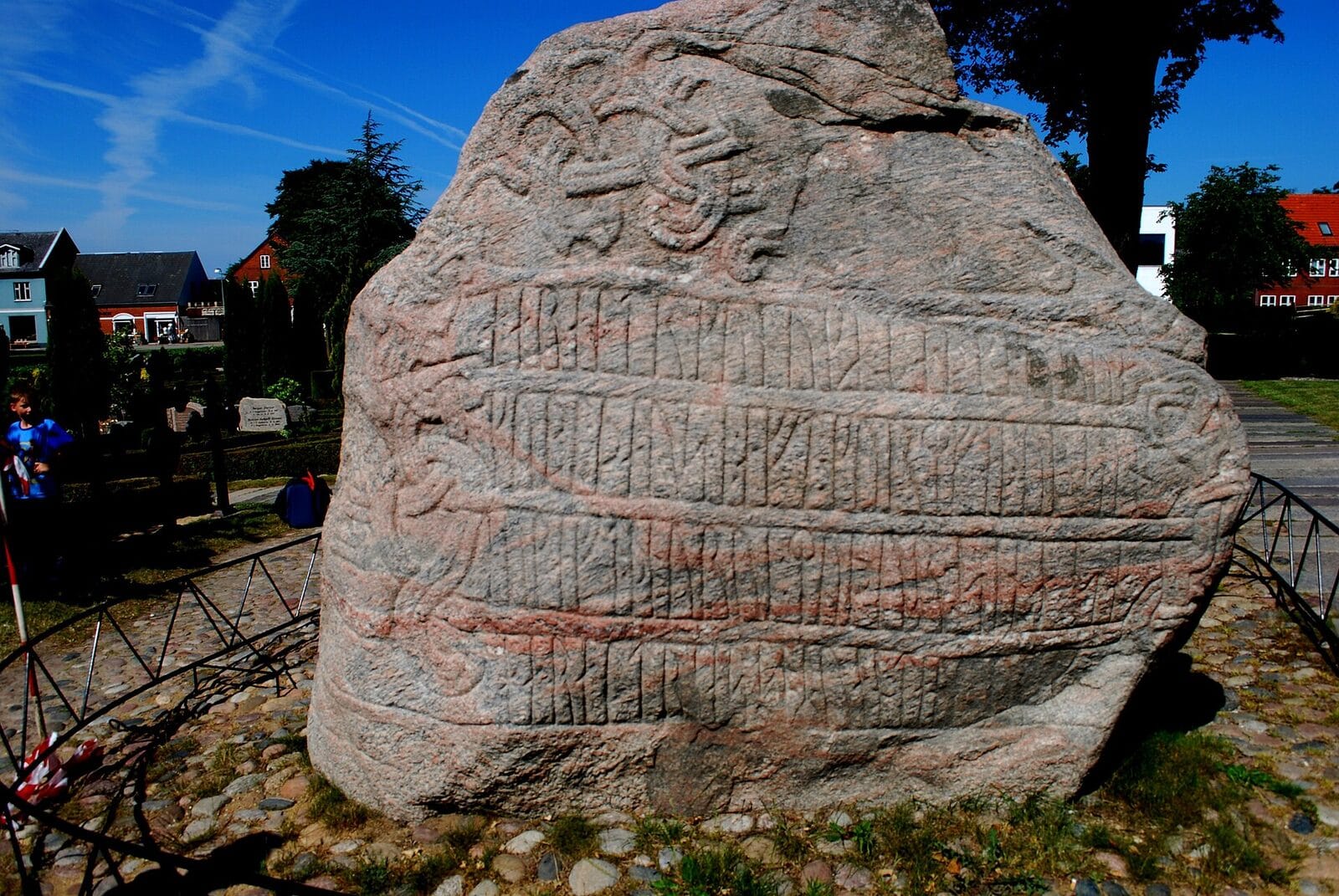
The rune face of the great Jelling stone — Harald Bluetooth's declaration, in Younger Futhark, that he "won all of Denmark and Norway and made the Danes Christian," around 965. Photo: Erik Christensen, CC BY-SA 3.0.
Bluetooth is named after a 10th-century king of Denmark, Harald "Bluetooth" Gormsson, who is remembered for uniting fractious Danish and Norwegian tribes under a single crown. The wireless standard was meant to do the same thing for an industry full of incompatible short-range radio schemes, so an Intel engineer named Jim Kardach proposed the king's nickname as a placeholder codename in 1996. The codename was never supposed to ship. It shipped anyway, and the logo you see on every headset and car stereo is a thousand-year-old bind-rune of the king's initials. This is one of the rare cases in technology where the marketing department lost and the engineers' in-joke became the permanent name.
Harald Blåtand, king of Denmark
Harald Gormsson ruled Denmark from roughly 958 to 986 and, for about fifteen of those years, controlled parts of Norway as well. He consolidated power over most of Jutland and Zealand, and — significantly for how he is remembered — converted the Danes to Christianity. His most durable monument is the larger of the two Jelling stones, a runestone he raised that declares, in Younger Futhark runes, that this is "the Harald who won the whole of Denmark and Norway and turned the Danes to Christianity." The Jelling stones are sometimes called Denmark's birth certificate, and they are a UNESCO World Heritage site.
The point that mattered to a group of telecom engineers in the 1990s was the uniting. Harald took a set of squabbling, separately-governed tribes and brought them under one rule. The wireless engineers were looking at a set of squabbling, separately-specified radio protocols and wanted to bring them under one standard. The analogy was clean, and it was Scandinavian, which suited a project led substantially out of Ericsson in Sweden and Nokia in Finland.
Why "Bluetooth," though
The nickname itself is genuinely uncertain, and the candidate explanations are worth laying out because the technology inherited the ambiguity along with the name. His name in Old Norse and Danish is Harald Blåtand — blå meaning blue, tand meaning tooth.
The simplest theory, and the one most often repeated, is literal: the king had a conspicuous dead or diseased tooth that had gone dark, a bluish or blackish colour, and the epithet describes it. A 12th-century chronicler described it in roughly those terms. The competing theories are linguistic. One holds that blå in older usage could mean dark more generally — dark-haired or dark-complexioned rather than blue-toothed. Another, more elaborate theory proposes an Anglo-Saxon route in which an original element meaning something like thegn (a chieftain or great man) was garbled in transmission back into Norse and reanalysed as tand, "tooth." The medieval sources do not settle it. What is certain is that the byname was attached to Harald centuries ago and that it contains the words for blue and tooth, which is all the engineers needed.
Jim Kardach's codename, 1996
The naming happened at a meeting in 1996. Jim Kardach of Intel was working with Ericsson and Nokia on standardising a short-range radio link to connect mobile phones, computers, and peripherals without cables. Kardach later explained that he proposed Bluetooth as a temporary code name because "King Harald Bluetooth … was famous for uniting Scandinavia just as we intended to unite the PC and cellular industries with a short-range wireless link." Kardach had reportedly been reading a historical novel about Vikings around that time, which is how the obscure Danish king was on his mind in an Intel meeting.
The key word is temporary. Bluetooth was a working title, the kind of internal codename that gets replaced by something focus-grouped before the product ships. The teams fully intended to choose a proper marketing name when the time came. Codenames-as-final-names have a track record in computing — see why Apache is called Apache, where a pun on "a patchy server" outlived every attempt to dignify it.
How the codename became permanent
The Bluetooth Special Interest Group — the body that owns and maintains the standard — was founded in September 1998 by five companies: Ericsson, IBM, Intel, Nokia, and Toshiba. (IBM later sold its personal-computer business and was effectively replaced in that role by Lenovo in 2005.) When the SIG came to pick the real, permanent name, the two leading candidates were RadioWire and PAN, short for Personal Area Networking.
Both candidates collapsed for unglamorous reasons. PAN turned out to be far too generic: an internet search returned tens of thousands of pre-existing hits, making it useless as a distinctive trademark. RadioWire was the preferred marketing choice, but the trademark search on it could not be completed in time for the launch. With the deadline closing and the proper name unavailable, Bluetooth — the placeholder everyone had been saying for two years — was the only option left that was clear to use. The codename shipped because the alternatives ran out the clock. The engineers' historical in-joke became the brand by default.
The logo is a bind-rune
The Bluetooth symbol is not an abstract glyph. It is a bind-rune — two runes merged into a single character, a real practice in runic writing — spelling the initials of Harald Bluetooth. The two component runes come from the Younger Futhark, the runic alphabet in use in Scandinavia during the Viking age. They are Hagall (ᚼ), which stands for H, and Bjarkan (ᛒ), which stands for B — the initials of Harald Blåtand. Overlay the two runes and you get the angular mark printed on a few billion devices.
It is a remarkably literal piece of design once you know what you are looking at: the logo for a wireless standard named after a Viking king is, in fact, that king's monogram written in the alphabet of his own century. Most technology logos that gesture at history are decorative. This one is functional — it is a name written in the correct script. The Kubernetes ship's wheel encodes a Star Trek joke in its seven spokes; the Bluetooth mark encodes a dead king's initials in tenth-century runes. Both reward the person who looks twice.
What the thing under the name actually is
It is worth grounding the metaphor in what Bluetooth technically does, because the uniting is not just a slogan — it is the engineering problem the specification solves. Bluetooth operates in the unlicensed 2.4 GHz ISM band, the same crowded slice of spectrum used by Wi-Fi, microwave ovens, and cordless phones. To coexist in that noisy band, it uses frequency hopping: the radio rapidly switches among 79 channels, dwelling on each for only 625 microseconds before jumping to the next. Two devices that have paired share the hopping pattern, so they stay in sync while interference on any single channel is shrugged off as the pair moves on. The protocol stack on top handles discovery, pairing, and a tower of profiles for specific uses — audio, file transfer, input devices, and the rest.
The first complete Bluetooth 1.0 specification was published in 1999, running to well over 1,500 pages — a measure of how much had to be standardised to make heterogeneous devices interoperate. The early 1.0 and 1.0B releases were notorious for interoperability problems, the exact failure the project existed to eliminate, and later versions spent considerable effort fixing them. In 2002 the IEEE adopted a version of the lower layers as the IEEE 802.15.1 standard, giving the SIG's work a formal home in the standards body that also governs Wi-Fi. The point is that a single specification, owned by a single group, is what lets a phone from one vendor and a speaker from another simply work together — which is the radio equivalent of bringing the tribes under one crown.
A standard that actually unites
The justification for the name was always the uniting metaphor, and on that score the name turned out to be earned. Before Bluetooth there was no single short-range wireless standard; there were competing proprietary radio schemes that did not interoperate. Bluetooth gave the industry one specification, governed by one SIG, that a phone from one manufacturer and a headset from another could both implement and trust to work together. That is precisely the structural problem Harald solved with tribes and the engineers solved with radios: replace many incompatible authorities with one shared standard. The metaphor is not just a cute story bolted on after the fact — it describes what the technology does.
It is worth noting how unusual this is. Most technology gets its name from a person's whim, a pun, an acronym, or a Greek word picked for resonance. Bluetooth is named for a specific historical figure because the engineers saw a genuine structural parallel between his achievement and theirs, picked the name as a joke, and then could not get rid of it. The metaphor survived because it was accurate.
A short close
Bluetooth is named after Harald "Bluetooth" Gormsson because he united the Danish tribes the way the standard unites wireless devices, and Jim Kardach proposed the name in 1996 expecting it to be a throwaway codename. It became permanent only because the real marketing names — RadioWire and PAN — fell through on trademark and search-distinctiveness grounds at the last minute. The logo is the king's initials, H and B, written as a bind-rune in the Younger Futhark runes of his own century. The whole thing is a Viking history lesson hiding on the back of a wireless earbud, kept alive by a trademark deadline that the engineers' in-joke happened to beat.
Read next