Why is your home network 192.168.1.1? The 1994 address war behind it
Three blocks of addresses were quietly set aside in 1994 with no explanation for the numbers, an opposition RFC titled 'Considered Harmful' predicted decades of pain, and the lead objector ended up co-signing the winning standard. Your router's default address is the armistice line.
AI-assisted postDrafted with help from Claude, edited and fact-checked by Mart. See transparency policy →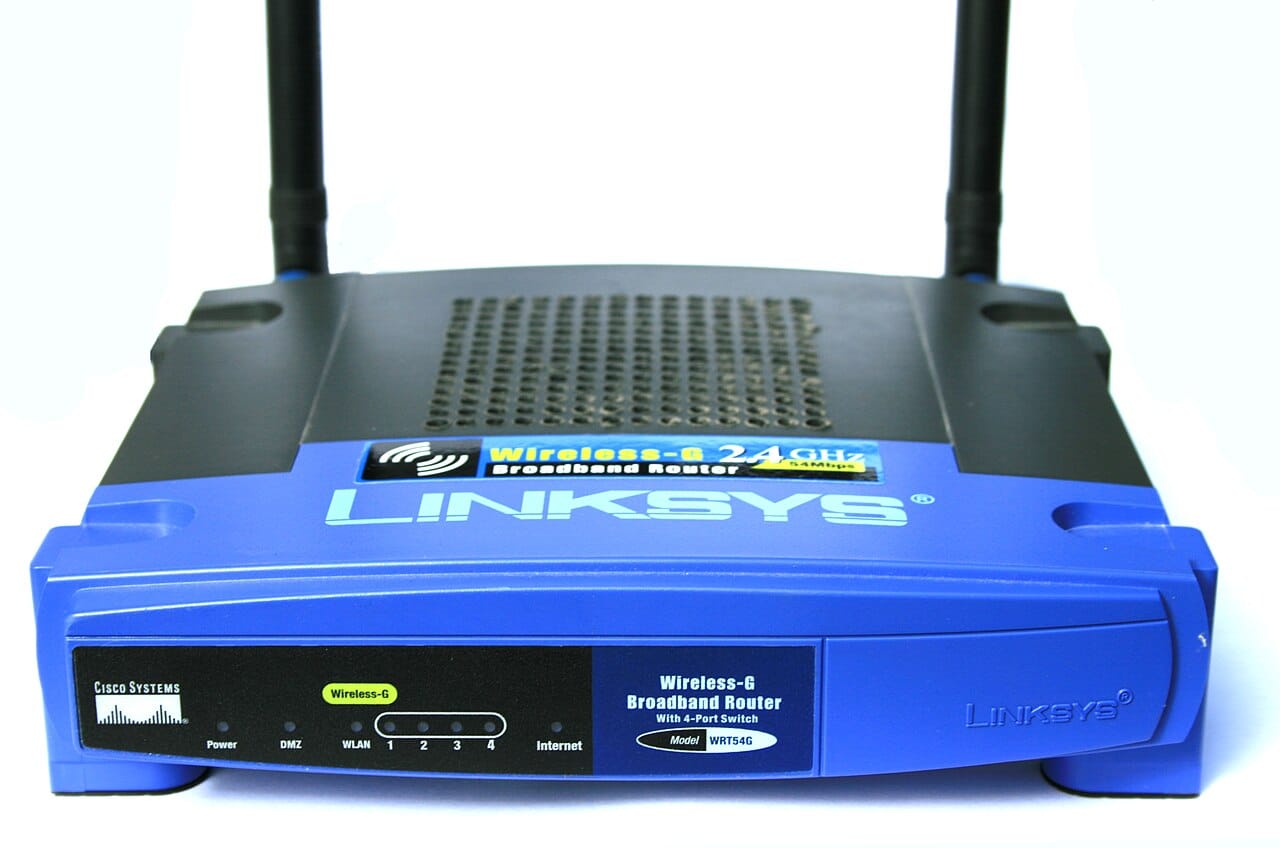
The Linksys WRT54G, the blue box that put 192.168.1.1 into a hundred million homes and made a vendor default feel like a law of nature. Photo by Jonathan Zander, CC BY-SA 3.0.

Every home router on Earth hands out addresses starting with 192.168, and if you ask why those digits, the answer is the same one this series keeps finding at the bottom of the internet: nobody wrote it down. But unlike 127.0.0.1, which one man reserved in silence, the private address ranges came out of an actual public fight — a standards war with a Considered Harmful paper, a prophecy of pain, and a peace treaty signed by the losing side.
March 1994: three blocks, no reasons
By the early 1990s the internet was visibly running out of IPv4 addresses, and most machines inside companies had no business being globally reachable anyway. So RFC 1597 (March 1994 — Rekhter, Moskowitz, Karrenberg, de Groot) reserved three blocks that would never be routed on the public internet, one sized for each class of network:
| Block | Size | Who ended up living there |
|---|---|---|
10.0.0.0/8 |
one class A, 16.7M addresses | enterprises, VPNs, clouds |
172.16.0.0/12 |
16 class Bs | the forgotten middle child — and, quietly, Docker's default bridge |
192.168.0.0/16 |
256 class Cs | every home network on the planet |
Why these numbers? The RFC1 describes the blocks — "the first block is nothing but a single class A network number" — and never justifies the selection. Same as 127: the ledger says so, and the ledger doesn't explain. The one number with a documented past life is 10: in Jon Postel's 1981 registry it belonged to ARPANET itself. The network that started the internet was decommissioned in 1990, and its address was recycled into private space — the birthplace of the internet is now every corporate VPN2.
🔗 Learn more — 1 What is an RFC?
🔗 Learn more — 2 What is a VPN (and how does WireGuard do it)?
July 1994: "Considered Harmful"
Four months later came the counterattack, and it is one of the great titles in the series: RFC 1627, Network 10 Considered Harmful (Some Practices Shouldn't be Codified) — Lear, Fair, Crocker, Kessler. Their argument was the end-to-end principle itself: the internet works because every machine has a globally unique address and any two of them can talk. Make addresses non-unique and you break that contract, and the bill arrives later — when companies merge, when isolated networks need to connect, when users want what they didn't anticipate wanting. They had receipts (Apple had just renumbered 5,000 hosts) and a prophecy:
"We condemn many thousands of organizations to similar pain when they too attempt to answer the call of the global Internet."
February 1996: the dissenter signs the treaty
The fight ended in the most standards-body way possible. RFC 1918 (February 1996) codified the three ranges as a Best Current Practice, laid down the law — routing information about private networks "shall not be propagated," packets with private addresses "should not be forwarded" — and formally obsoleted both RFC 1597 and RFC 1627: the proposal and the objection, absorbed into one document. And among its authors, alongside the original four: E. Lear — lead author of Considered Harmful. The dissenter co-signed the final standard, which is either a defeat or the process working exactly as designed, depending on your reading. Together with NAT, invented the same year as the objection, private addressing became the default architecture of the entire consumer internet.
So why does your router say 192.168.1.1?
Layer two of the same pattern: vendor convention, never standardized. 192.168.0.0/16 was the block sized for small networks, so consumer router makers in the late 1990s each picked a default subnet3 out of it — Linksys settled on 192.168.1.x with the router at .1, others on 192.168.0.1, and the defaults fossilized into millions of manuals and muscle memories. Nobody chose 192.168.1.1 for the internet; a product manager chose it for a router box, and the way these things go, the shipped default became the standard nobody voted on. If you run a homelab, odds are your whole empire lives at addresses one company's default config picked before you owned a computer.
🔗 Learn more — 3 What is a subnet?
How NAT actually pulls it off
The reason a thousand devices can share one public address deserves two paragraphs, because it is the trick the whole consumer internet balances on. Your router keeps a translation table: when 192.168.1.37 opens a connection to a website, the router rewrites the packet to come from its own public address on some ephemeral port, notes the mapping, and reverses it for the replies. Outbound connections write entries into the table; inbound packets without an entry have nowhere to go and die at the door. That asymmetry is NAT's entire security reputation and its entire brokenness at once: nothing can reach your devices uninvited, including the things you want to reach them — which is why game consoles whine about "NAT type," why every peer-to-peer app carries a toolkit of hole-punching tricks, and why reaching your own homelab from outside means port-forwarding, tunnels, or surrender.
The private ranges also collide in exactly the way RFC 1627 predicted, just in miniature. Merge two offices that both picked 192.168.1.0/24 and the VPN cannot tell whose .1.37 is whose — someone renumbers, painfully, thirty years after Apple did. Docker defaults its bridge to 172.17.0.0/16, which is why half of all corporate-VPN-plus-Docker setups eventually produce an afternoon of "why can't I reach staging": the container network and the office network drew the same straw from the 1918 hat. The addresses are private, but the collisions are shared.
The rest of the reserved map
192.168 has siblings — the IPv4 space is dotted with special-purpose carve-outs, and recognizing them on sight is a minor sysadmin superpower:
| Range | Meaning | When you meet it |
|---|---|---|
169.254.0.0/16 |
Link-local (APIPA) | The address of failure. A machine that gave up waiting for DHCP assigns itself one of these. Seeing 169.254.x.x means "the network is broken, and I improvised" |
100.64.0.0/10 |
Carrier-grade NAT (RFC 6598, 2012) | RFC 1918's sequel: a private range for ISPs, so your router's "public" side can itself be behind NAT. If your WAN address starts with 100.6x–100.12x, you're double-NATed and truly unreachable |
192.0.2.0/24 (+2 others) |
TEST-NET, for documentation | Example addresses that must never route, so tutorials can't hijack real machines — the foo and bar of IP addresses |
224.0.0.0/4 |
Multicast | One-to-many delivery; where mDNS/Chromecast discovery lives |
240.0.0.0/4 |
"Reserved for future use" | The future never came: ~268 million addresses parked since 1981, so incompatible with deployed software that even the exhaustion crisis couldn't unlock them |
127.0.0.0/8 |
Loopback | Sixteen million ways of talking to yourself |
Read the table's dates and a pattern emerges: every entry is a decision from 1981–2012 that is now permanent, and the sum of the permanently-unusable space (240/4 alone, plus loopback's excess) is over a quarter-billion addresses — parked forever during a shortage, because the installed base is more immovable than the scarcity is painful. IPv4 ran out with the pantry full.
The prophecy's scorecard
Thirty years on, the Considered Harmful authors deserve a verdict, and it's split. They lost the war completely: private space + NAT scaled the internet to billions of devices IPv4 could never have addressed directly, and the exhaustion crisis they wanted solved properly was deferred for two decades. But their prophecy aged uncomfortably well: NAT did break end-to-end connectivity, which is why peer-to-peer anything is a punishline of hole-and-relay tricks, why your homelab needs tunnels to be reachable, and why CGNAT stacks NAT on NAT until some connections simply cannot happen. The pain arrived, as condemned, just spread thin enough across the decades that nobody sent the bill back to 1994. And the "real fix" they were holding out for — every device globally addressable again — shipped as IPv6 and has spent twenty years being adopted at the speed of continental drift, because 192.168 works just well enough to never leave.
192.168: one of three private blocks from RFC 1597 (1994), codified in RFC 1918 (1996) over a "Considered Harmful" objection whose lead author co-signed the final standard. The specific numbers were never explained; network 10 is recycled ARPANET; your router's .1.1 default is a vendor convention that fossilized. Nobody decided any of it — it shipped.
Read next