Where the word firewall comes from
Before it filtered packets, a firewall was a literal wall — a fire-resistant barrier in buildings from the 1850s, then the iron bulkhead behind a vehicle's engine. The networking sense borrowed the metaphor in the late 1980s and was cemented by Cheswick and Bellovin's work at Bell Labs.
AI-assisted postDrafted with help from Claude, edited and fact-checked by Mart. See transparency policy →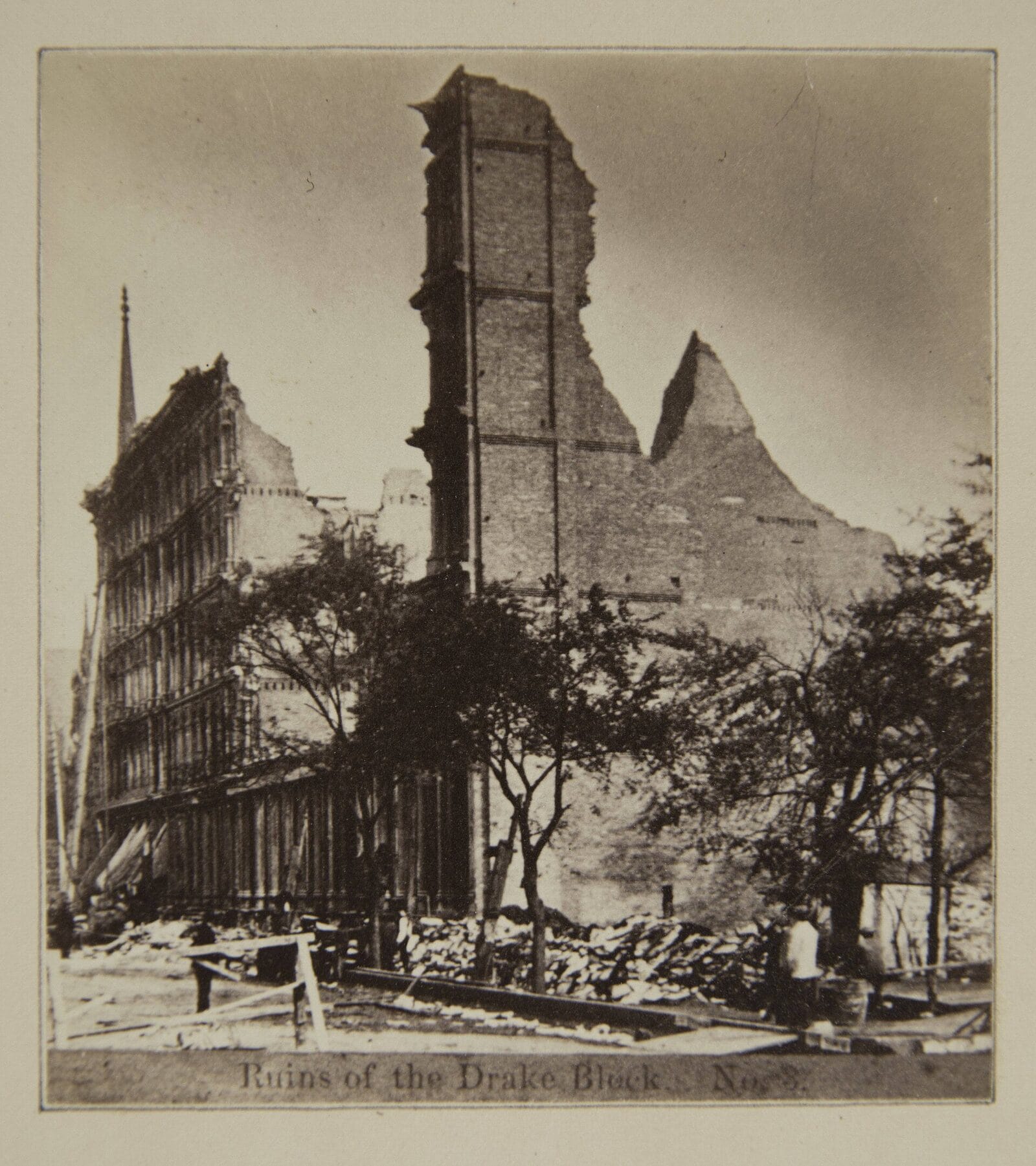
Ruins of the Drake Block, Great Chicago Fire, 1871 — a lone masonry wall standing where everything else burned. Public domain.
A firewall sounds like a computing invention, but the word was doing its job for more than a century before it ever touched a network. It started as a piece of architecture, moved into engineering, and only became a security term in the late 1980s when someone needed a name for the thing standing between a trusted network and a hostile one.
The literal wall
The original firewall is exactly what it says: a fire-resistant wall built to stop fire spreading. The term is recorded from around 1851 for a barrier wall in a building designed to contain a blaze to one section (Etymonline). The idea is purely physical — a wall dense enough that flames on one side do not reach the other.
The metaphor sharpened with machinery. In vehicles, the firewall is the bulkhead between the engine compartment and the passenger cabin: if the engine catches fire, that wall buys the occupants time. This is the version most people have actually stood next to, and it carries the key idea the computing sense would later borrow — a deliberate barrier that lets the useful stuff through (pedals, wiring, controls pass the cabin firewall) while holding back the dangerous stuff (heat, flame).
The jump to networking
The computing meaning is figurative, and it emerged in the late 1980s as a name for a device that blocks unwanted network traffic while letting wanted traffic pass (Firewall (computing) — Wikipedia). The earliest use that maps onto a security device appears to be by Steve Bellovin, in a 1987 email — though, tellingly, Bellovin himself has said he does not think he invented the term; the person he wrote to already knew what he meant (CERIAS, Purdue). That is how borrowed metaphors usually arrive: not coined in a flash, but quietly reused until everyone agrees on the meaning.
The concept was made concrete at AT&T Bell Labs, where Bill Cheswick and Steve Bellovin worked on packet filtering and built early firewall architectures. The first published description of a modern firewall using that name came in Practical UNIX Security (written 1990, published 1991), and Cheswick and Bellovin's own Firewalls and Internet Security (1994) became the foundational text (Wikipedia).
Why the metaphor fits so well
The networking sense kept everything that made the physical one useful. A network firewall is a deliberate barrier placed between zones of different trust — the open internet on one side, your network on the other — and its whole purpose is selective passage: permit the traffic you want, block the traffic you do not, just as the vehicle bulkhead passes the controls but stops the flames. The hardening firewall on a public VPS is the same idea in practice — open exactly four ports, drop everything else.
It is one of computing's more honest metaphors. A firewall really does what a firewall has always done: it stands between something dangerous and something you want to protect, and only lets the safe things through.
Sources
Read next