Why is it called a 404? There was never a room 404
The web's most famous number has a beloved origin story involving an office at CERN where the first server lived. The web's own pioneers call the story hogwash. The real answer is duller, older, and better: the digits are a sentence, and you can read them.
AI-assisted postDrafted with help from Claude, edited and fact-checked by Mart. See transparency policy →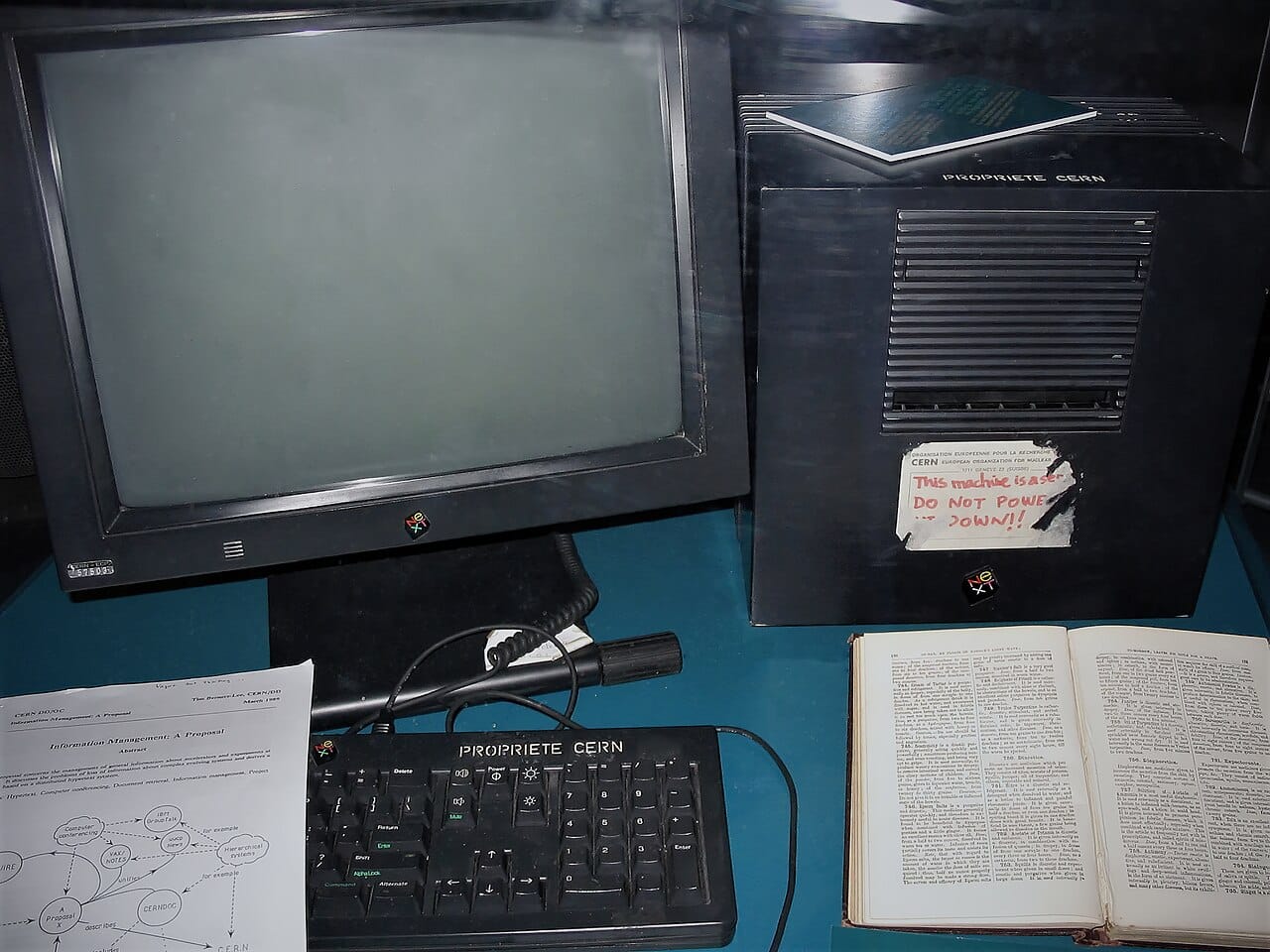
The first web server: Tim Berners-Lee's NeXT cube at CERN, hand-labelled "This machine is a server. DO NOT POWER IT DOWN!!" It served the web's first not-found errors; it did not live in room 404. Photo by Coolcaesar, CC BY-SA 3.0.

The most famous error number on Earth has a creation myth. It goes: at CERN, where Tim Berners-Lee built the web, the first server lived in room 404, and when a file could not be found, the answer came back "room 404: not found" — so the number is a place, a shrine even, the room where the web began. It is a lovely story, and the people who were actually there call it hogwash. That is the word used by web pioneer Robert Cailliau, Berners-Lee's closest collaborator. There is no room 404 at CERN: in CERN's numbering, building 4's offices start at 410 — the room the legend venerates does not exist to this day.
What the digits actually say
The truth is not a room; it is a grammar. HTTP inherited the three-digit reply-code convention from the older internet protocols — FTP, SMTP, NNTP all spoke in numeric sentences long before the web. In that grammar each digit has a job:
- First digit — who failed.
4xxmeans the client erred: you asked for something wrong. (5xxmeans the server erred,2xxmeans all is well,3xxmeans look elsewhere.) - Last two digits — how, exactly.
04is the specific complaint: not found.
So 404 is a sentence, read straight through: your mistake (4), the thing you named does not exist here (04). Its neighbors say the rest — 403 your mistake, you may not have it; 401 your mistake, you have not said who you are; 400 your mistake, I cannot even parse the request. Nobody's office number is encoded anywhere. The web's most famous number is a coordinate in a table, chosen because the table needed a row, in a numbering scheme older than the web itself.
Why the myth wins anyway
The room-404 legend persists for the same reason daemon grew a fake acronym and ping grew a fake expansion: humans find stories stickier than systems. "The room where the web began" has a door, a place, a pilgrimage; "the fourth row of the client-error class" has a specification. Etymology folklore is nearly always like this — the false version is concrete and cinematic, the true version is structural and quiet. This series keeps finding the same rule: when a technical name has both a romantic origin story and a boring one, bet boring, then check.
And 404 did something none of its table-mates managed: it escaped. Nobody says "I got 403'd" at a party, but 404 is shorthand for absence in ordinary speech — minds go 404, people 404 from plans. A number chosen by protocol bookkeeping became a word, the way tools' names keep doing, and the myth about the room is arguably part of why: a number that has a shrine is easier to love than a row in a table. The shrine just happens to be an address that doesn't exist — which, for the not-found error, is almost too fitting.
404: not a room at CERN — Robert Cailliau, who was there, calls that story hogwash, and building 4's offices start at 410. It is a grammar inherited from pre-web protocols: 4 = the client erred, 04 = not found. The boring answer, as usual, is the true one.
Read next