What does CAPTCHA stand for? The Turing test, running in reverse
The squiggly letters guarding every signup form are a 1950 thought experiment turned inside out: a human laboring to convince a machine it is not one. The acronym says exactly that, and the words it made you type were quietly put to work.
AI-assisted postDrafted with help from Claude, edited and fact-checked by Mart. See transparency policy →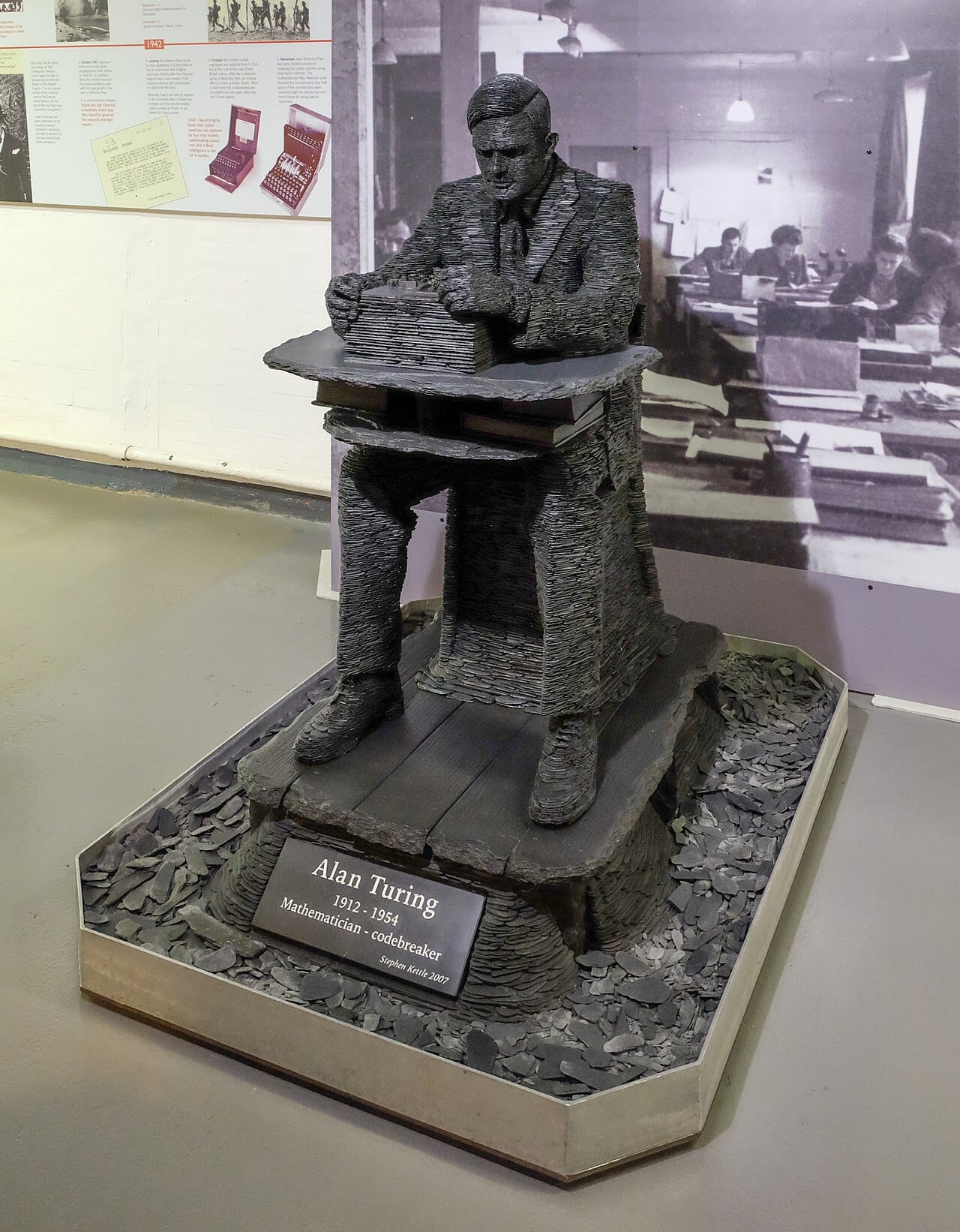
Alan Turing in half a million pieces of slate, at Bletchley Park. His 1950 test asked if a machine could pass for human; the CAPTCHA asks you to. Statue by Stephen Kettle; photo by DeFacto, CC BY-SA 4.0.

CAPTCHA is a contrived acronym for Completely Automated Public Turing test to tell Computers and Humans Apart, and unlike most acronyms in this series, it is not a backronym, a pun, or an accident. It was coined in 2003 by Luis von Ahn, Manuel Blum, Nicholas Hopper and John Langford at Carnegie Mellon, engineered to say precisely what the thing is — and what it is, is one of the strangest inversions in computing: Alan Turing's 1950 thought experiment, flipped.
The inversion
Turing's original imitation game put a machine on trial: converse with a hidden interlocutor, and if you cannot tell it is a computer, the computer passes. The stakes ran one way — machines aspiring to be mistaken for us.
A CAPTCHA runs the same trial with the roles swapped, which is why it is sometimes called a reverse Turing test: the judge is a machine, the suspect is you, and the thing under examination is your humanity. Squint at warped letters, click the traffic lights, prove you are not a robot — billions of times a day, humans perform for an automated examiner, aspiring to be mistaken for humans. Turing asked whether machines could pass as people; the web's daily liturgy asks people to pass as people, to a machine's satisfaction. The name encodes the whole reversal: a Turing test that is completely automated — no human on either side of the bench except the defendant.
The trick inside the trick
The technology predates its name — idrive used such a test on its signup page in 2000, PayPal by 2001 — but the era worth remembering is what von Ahn did next. reCAPTCHA, acquired by Google in 2009, harvested the proof-of-humanity labor: the distorted words you typed were scans that OCR had failed on, and your answers digitized the archives of The New York Times and the books of Google Books. Two birds, one chore: every login gate was also a transcription bench, and humanity collectively typed old newspapers into the digital record while trying to read its email. Whatever else one thinks of it, it is the most productive security theater ever staged.
A name with an expiry date
Here is what makes CAPTCHA the odd one out in this lane: grep, daemon and foo fossilized — names that outlived their eras intact. CAPTCHA's name contains a claim — that a fully automated test can tell computers and humans apart — and the claim is dying in public. Modern models read warped text and count traffic lights better than tired humans do; the tests have retreated into invisible behavioral scoring precisely because the visible puzzles stopped working, and having AI judge AI has its own structural problem. The acronym may be the first in this series to become false while still in daily use: a Completely Automated Public Turing test that can no longer, in fact, tell Computers and Humans Apart. The name said exactly what the thing was. Eventually that may be the epitaph.
CAPTCHA: Completely Automated Public Turing test to tell Computers and Humans Apart — coined 2003 at Carnegie Mellon by von Ahn, Blum, Hopper and Langford; a reverse Turing test where the machine judges the human. reCAPTCHA turned the proof into unpaid transcription that digitized the NYT archive and Google Books.
Read next