What we mean when we say 'the cloud'
The cloud was a network-diagram icon for two decades before it was a product. Compaq coined cloud computing in 1996, AWS made it real in 2006, and the surrounding vocabulary — VPS, hyperscaler, colocation — each carries its own history.
AI-assisted postDrafted with help from Claude, edited and fact-checked by Mart. See transparency policy →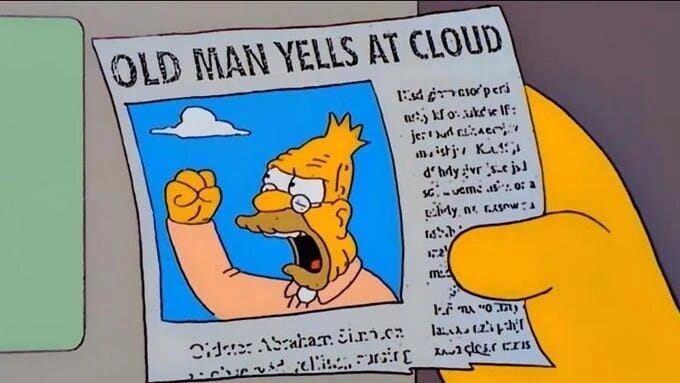
"Old Man Yells at Cloud," from The Simpsons (Fox / 20th Century Studios / Disney), 2002. The image is the cultural shorthand for taking the cloud too seriously, and it predates the AWS launch that gave the word a product category by four years.
The cloud was an icon before it was a product
Network engineers and telecoms have been drawing clouds in their architecture diagrams for decades. Long before the word was applied to a product category, the cloud symbol meant somebody else's network, behave at the boundary, and do not try to model what's inside. Phone-system engineers drew clouds for the PSTN. ARPANET researchers drew clouds for the IMPs they did not control. Enterprise architects drew clouds for the WAN circuits they leased from a carrier and could only debug through a support ticket.
The icon was already, in 1980s and 1990s engineering practice, a precise piece of notation: anything inside the cloud is the responsibility of a provider, and everything outside it is yours. When the industry eventually invented a product category that matched that notation exactly — buy a service, do not own the inside of it — it took the icon and ran with it. Most of the difficulty around defining the cloud later on stems from the fact that the symbol was carrying a clear meaning for a generation of engineers before anyone tried to sell it.
Compaq coined "cloud computing" in 1996
The phrase itself has a documented origin in late 1996, inside Compaq Computer Corporation. Two executives — George Favaloro, then VP of Compaq's Internet Solutions Division, and Sean O'Sullivan, a consultant who would later co-found NetCentric — used the phrase in working sessions over the autumn of that year. O'Sullivan's daily planner from 1996-10-29 has the line "Cloud Computing: The Cloud has no Borders" jotted down following a meeting with Favaloro. Two weeks later, on 1996-11-14, Favaloro produced a 50-page internal Compaq strategy document titled Internet Solutions Division Strategy for Cloud Computing. The phrase first existed in print as a category label for a Compaq business unit's roadmap.
The pitch inside Compaq was not what the term came to mean a decade later. Favaloro and O'Sullivan were thinking about Compaq's hardware as the substrate that other companies would buy to build internet-delivered software on top of — the idea was about selling the picks and shovels of a coming wave of network applications, not about reselling compute by the hour. The phrase went dormant in industry use for roughly ten years after the strategy doc circulated. The MIT Technology Review piece Who Coined 'Cloud Computing'? carries the photographs of both the planner and the Compaq cover sheet.
2006: AWS made the cloud real, Eric Schmidt named it in public
Two events in 2006 turned a dormant phrase into a market category.
On 2006-03-14, Amazon Web Services launched S3 as a public service. Anyone with a credit card could store data on Amazon's infrastructure and pay only for what they used, with no contract and no minimum commitment. Five months later, on 2006-08-25, AWS launched EC2 in beta — rent a virtual machine by the hour, on the same model. Both came out of an internal Amazon paper written in late 2003 by Chris Pinkham and Benjamin Black describing what Amazon's retail infrastructure could look like if it were standardised, automated, and exposed via web services. The last page of that paper contains the line that Amazon could also sell access to virtual servers as a service, which is the suggestion that eventually became EC2. AWS itself has retold the story in its eight-years-of-cloud-computing retrospective.
Two weeks before EC2 launched, on 2006-08-09, Google's then-CEO Eric Schmidt used the phrase "cloud computing" during a panel at the Search Engine Strategies conference. Schmidt did not coin the term — Compaq had already done that ten years earlier — but his framing positioned cloud computing as the future of computing rather than as one product category among many, and the trade press picked the phrase up over the following weeks. By the end of 2006, "cloud computing" was both a product (AWS) and an industry label (Schmidt's framing), and the two reinforced each other. From that point on the word stopped drifting and the category stopped being negotiable.
VPS: the cloud's older sibling
Before the cloud was branded as the cloud, the same underlying primitive was already being sold as a virtual private server. The technology piece arrived in two waves.
In March 2000, FreeBSD 4.0 shipped with jail — a kernel-level tenant-isolation mechanism developed by Poul-Henning Kamp and committed to FreeBSD in 1999. The work was originally motivated by a small hosting company called R&D Associates, whose owner Derrick T. Woolworth wanted a clean, enforceable separation between his company's services and his customers' services on the same physical host. Jail was the first widely-deployed open-source tenant-isolation primitive on a serious server operating system, and small hosting providers started selling FreeBSD-jail-based virtual hosting almost immediately.
In 2001, VMware ESX Server launched and made full hardware-level virtualisation practical on commodity x86. Partitioning a single physical server into multiple independent virtual ones stopped being exotic and started being the default deployment model for hosting providers. By 2003-2004, VPS hosting was a recognised product category — you got a virtual machine, you got root, you paid by the month, and the provider managed everything below your operating system.
What the cloud added on top of VPS, when AWS arrived in 2006, was per-hour billing rather than per-month, a fully programmable API rather than a control panel, and effectively unlimited horizontal scale rather than one machine at a time. VPS sells you one virtual machine, fixed-spec, on a monthly subscription. Cloud sells you the ability to spin up a thousand virtual machines and tear them down again before lunch, billed by the hour or second.
Hyperscaler: a vague term that found a meaning
The word hyperscale started its life in the late 1990s as data-center jargon, referring to buildings that were significantly larger than the typical enterprise data center — hundreds of thousands of square feet, custom cooling, dedicated substation-level power feeds, and the ability to absorb step-function increases in load. The early usage described the physical facility, not the software running inside it. Through the 2000s the meaning slid: a hyperscale system became a software system that absorbs capacity by adding more nodes rather than by upgrading individual machines, and a hyperscaler became the company operating that kind of system at the scale where it actually mattered. Ocient has a useful walk-through of how the word travelled from describing buildings to describing workloads.
By the early 2010s the word had narrowed again, this time to describe a small set of companies (AWS, Microsoft Azure, Google Cloud, eventually Meta and ByteDance) whose entire business model depended on operating at a scale most enterprises never approach. The current 2026 usage is roughly: a hyperscaler is a cloud provider with enough physical and operational capacity to run other companies' entire infrastructure as a service. The LLM era pulled the term into the mainstream business press around 2023, because the same handful of companies turned out to be the only ones with enough GPU capacity to train and serve frontier models at production scale. The meaning of the word is not new; the cultural awareness of what the word names is.
The current taxonomy, briefly
The vocabulary around the cloud accumulated layer by layer. The current 2026 layout, briefly:
- Colocation (colo) — you bring your own hardware. The provider gives you rack space, power, cooling, and a cross-connect. The provider does not touch your servers.
- Dedicated hosting — the provider owns the hardware and rents the whole machine to you. You manage the operating system upward.
- VPS — the provider runs hardware-level or kernel-level virtualisation and rents you a slice of a machine that looks like a whole machine. You manage the OS upward. Pricing is typically monthly.
- IaaS / cloud (infrastructure as a service) — VPS plus a programmable API plus per-second billing plus effectively unlimited horizontal scale. AWS EC2, Google Compute Engine, Hetzner Cloud, DigitalOcean droplets.
- PaaS / cloud (platform as a service) — the provider also manages the OS, runtime, and platform; you upload code. Heroku, Fly.io, Render, AWS App Runner, Google Cloud Run.
- SaaS / cloud (software as a service) — you do not manage anything; you log into a web app. Gmail, Notion, Snowflake, GitHub.
- Hyperscaler — a cloud provider operating at a scale large enough that their infrastructure economics are meaningfully different from everyone else's. In practice in 2026: AWS, Microsoft Azure, Google Cloud, and depending on definition Alibaba Cloud and Oracle Cloud.
The taxonomy is layered rather than mutually exclusive. A SaaS product usually runs on PaaS, which usually runs on IaaS, which usually runs on a hyperscaler. A typical 2026 startup is using all four layers without ever directly negotiating with any of them.
A short close
The cloud is, in physical terms, mostly other people's racks with a great deal of software in front of them. The word is a 1990s rebrand of an even older networking icon, the product category is twenty years old this year, and the surrounding vocabulary keeps drifting as new layers of abstraction get bolted on top. None of that makes the abstraction less useful — the per-hour billing, the programmable API, the horizontal scale, and the operational outsourcing are all real value, and the world that built itself on top of those primitives since 2006 would not have existed without them. It is worth knowing, all the same, that the word you reach for in a design meeting is one of the more recently invented terms in computing, and most of what it describes is older than the word itself.
Read next